Hydatis Insights · Issue 01
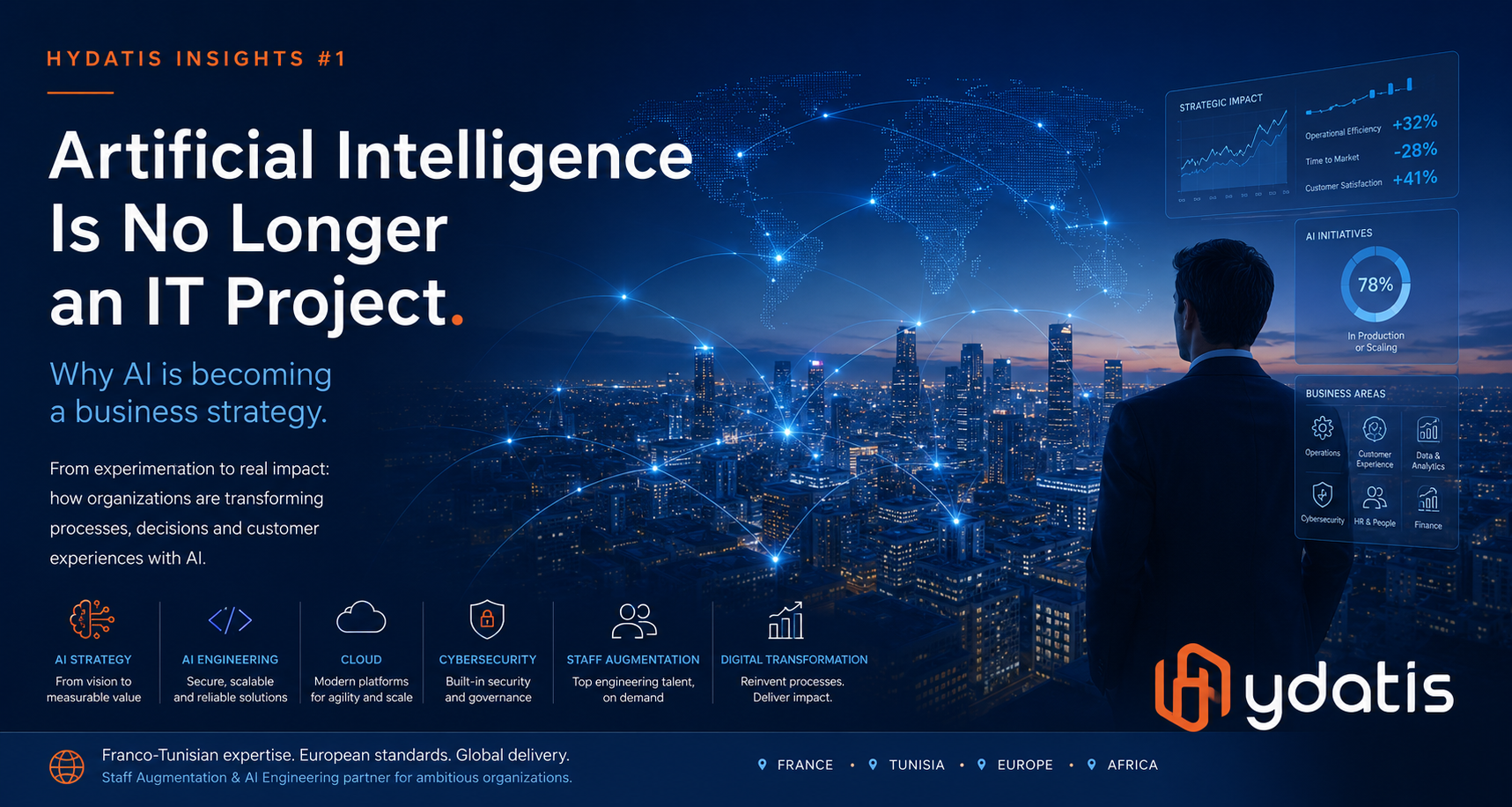
Artificial Intelligence Is No Longer an IT Project: Why AI Is Becoming a Business Strategy
For most of the last decade, artificial intelligence lived in a specific place inside the organization: a line item in the IT budget, a project owned by the data team, a pilot that either graduated to production or quietly disappeared. That model made sense when AI meant a handful of narrow use cases — a recommendation engine, a fraud filter, a chatbot bolted onto a support queue. It was a technical capability you deployed, not a strategic question you answered.
That model is now the wrong one, and the companies still operating inside it are the ones falling behind.
From a project with a budget to a decision with consequences
The shift is not that AI got more powerful, though it did. The shift is that AI capability now touches decisions that used to sit squarely in the strategy function: what your product does, how your customers experience it, which parts of your operating model can be reinvented rather than merely optimized. A generative AI feature is not just a technical add-on anymore — it can change what customers expect a product category to do at all. A well-designed decision-support model doesn’t just speed up a process — it can change who makes the decision and how much judgment a human role still requires.
When those are the stakes, “delegate it to IT” stops being a viable governance model. Not because IT teams lack the skill — they don’t — but because the questions AI now raises (which capabilities to build, which risks to accept, which parts of the business to restructure around them) are strategic questions. They belong at the same table as market positioning and competitive strategy, not three levels below it in a technology roadmap.
What changes when AI moves up a level
Treating AI as a business strategy rather than an IT project changes three things in practice.
Ownership. The question stops being “does IT have capacity for this” and becomes “does this belong in how we compete.” That reframing pulls the decision toward the leadership team — not to slow it down with committees, but because only leadership has visibility into where it actually creates advantage versus where it’s a distraction.
Risk framing. A technical AI project gets measured on accuracy and uptime. A strategic AI initiative gets measured on business exposure: what happens if a model is wrong at scale, what happens if a competitor moves faster, what happens if the organization builds capability it can’t govern. That’s a different risk conversation, and it needs different people in the room — not just data science, but legal, operations, and the people who own customer trust.
Talent. Technical AI expertise and business-fluent AI judgment are not the same skill, and most organizations are short on the second one far more than the first. The talent gap that actually slows companies down isn’t “we don’t have machine learning engineers” — it’s “we don’t have anyone who can translate a model’s real capability and real limits into a decision the board can act on.”
This isn’t just a large-enterprise problem
It’s tempting to read all of this as a concern for organizations with the budget of a Microsoft or an Accenture. In practice, we’ve seen the opposite: mid-size companies and public institutions often feel the strategic weight of AI decisions more acutely, precisely because they can’t absorb a wrong bet the way a larger organization can.
We’ve applied artificial intelligence to real operational problems where the stakes were exactly this kind of strategic, not purely technical — for example, building fraud detection models for insurance claims, where the real difficulty was never the algorithm. It was deciding how much authority to hand the model, how to keep experienced claims handlers in the loop rather than replaced by it, and how to explain a flagged case in a way a human could still act on. Those are governance and organizational-design questions wearing a technical coat — which is exactly the pattern showing up everywhere AI adoption is maturing.
What leadership teams should actually do with this
None of this argues against IT ownership of AI delivery. Engineering teams should absolutely own how a model gets built, deployed, and maintained — that discipline doesn’t disappear. What changes is where the decision to pursue a given AI capability gets made, and who’s accountable for its consequences beyond the technical ones.
A useful test: if an AI initiative fails, does the postmortem only involve the technical team, or does it also involve the people who own the business outcome it was meant to serve? If it’s only the former, the initiative was never treated as a strategic bet — it was treated as a project, and it will keep being sized, resourced, and governed like one.
The organizations pulling ahead right now aren’t necessarily the ones with the most advanced models. They’re the ones that stopped asking “can IT build this” and started asking “should this be part of how we compete” — and built the governance, talent, and accountability to match the answer.

Imed Ammar
Founder & President, Hydatis · 25+ years building technology organizations · Full bio
Related reading
- The “Old-School” Expertise is Dead: Today’s Expert Combines Know-How with AI Tools
- Quel Type d’Intelligence Artificielle pour Traiter la Fraude à l’Assurance
- Artificial Intelligence & Data services
Frequently asked questions
Is AI still primarily an IT department responsibility?
Delivery and engineering discipline should stay with IT. But the decision to pursue a given AI capability — and accountability for its business consequences — belongs with leadership, not IT alone.
How do we start treating AI as a strategic initiative rather than a technical project?
Start by changing who’s in the room when an AI initiative is approved and reviewed. If only the technical team is present, it’s still being governed as a project, not a strategic bet.
What’s the biggest risk of keeping AI decisions inside IT alone?
Business exposure gets under-assessed. Technical teams measure accuracy and uptime; they’re rarely positioned to weigh competitive risk, customer trust, or organizational redesign — and those are exactly what’s at stake once AI touches products and operating models.
Does this apply to mid-size companies, or only large enterprises?
If anything, it matters more for mid-size organizations and public institutions — they typically can’t absorb a wrong AI bet as easily as a large enterprise can.
How does Hydatis help with this?
We work at both levels — applying AI to real operational problems (like fraud detection for insurance claims) while helping leadership teams frame the governance, risk, and talent questions that come with it.